Light + Building 2026 Recap: High-Efficiency LED Innovation
March 16, 2026
Read:543
Source: Ledestar
2026 Light & Building Frankfurt
The 2026 Light + Building exhibition once again brought together lighting professionals from around the world. As one of the most influential events in the lighting industry, the exhibition provides a platform where manufacturers, designers, and technology providers present their latest innovations and discuss the future direction of lighting technology.
For Ledestar, the event was an opportunity to introduce a range of high-efficiency LED solutions designed to meet the evolving needs of modern lighting applications. With growing industry attention on energy efficiency, spectral quality, and modular design, the company presented several technologies that reflect these priorities.
Visitors to the Ledestar booth showed strong interest in the company’s LED chips for outdoor lighting, horticulture lighting, and modular lighting systems. These products demonstrate how improvements at the LED chip level can directly influence the performance of lighting fixtures used in real-world applications.
High-Lumen LED Chips Designed for Outdoor Lighting
Outdoor lighting continues to demand LED solutions that combine strong luminous output with long-term reliability. Applications such as street lighting, highways, stadiums, and industrial areas require fixtures capable of delivering high brightness while maintaining stable performance over many years of operation.
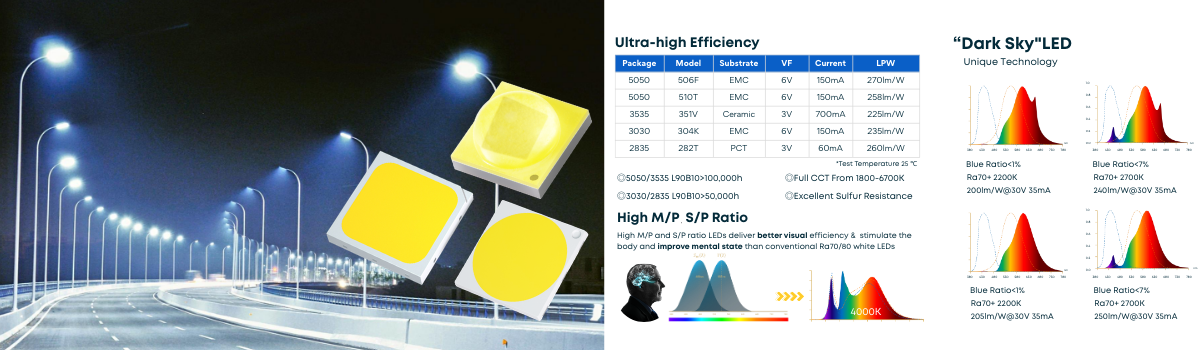
Ledestar presented a new generation of high-lumen LED chips developed specifically for these demanding environments. By optimizing chip structure and packaging technology, these LEDs can deliver strong luminous output while maintaining high efficiency. This allows lighting manufacturers to achieve powerful illumination while keeping energy consumption under control.
Another advantage of high-lumen LED chips is their ability to simplify luminaire design. When each LED can produce more light, manufacturers can reduce the total number of components required in a fixture. This can improve thermal management, reduce system complexity, and ultimately enhance overall product reliability.
Low Blue Light and Spectral Optimization
In recent years, the lighting industry has begun paying closer attention to the spectral characteristics of light. While brightness and efficiency remain important, designers are also considering how light affects visual comfort and the nighttime environment.
Ledestar introduced LED solutions with optimized spectral distribution that reduce excessive blue light content while maintaining high luminous performance. Lower blue light output can help reduce glare and improve visual comfort, particularly in outdoor environments where lighting is used throughout the night.
This type of spectral optimization reflects a broader shift toward more responsible lighting design. As cities and municipalities seek to balance illumination needs with environmental considerations, LED technologies that offer better spectral control are becoming increasingly valuable.
Optimizing M/P Ratio and S/P Ratio in Modern Lighting
Spectral engineering also makes it possible to improve lighting performance in more subtle ways. During the exhibition, Ledestar highlighted LED solutions designed with optimized M/P ratio and S/P ratio, two parameters that are gaining attention in modern lighting evaluation.
The M/P ratio relates to the relationship between melanopic and photopic light response, which is associated with how light influences human circadian rhythms. Lighting systems with appropriate spectral balance can help create environments that feel more natural and comfortable.
The S/P ratio, meanwhile, is related to how brightness is perceived under low-light conditions. Higher S/P ratios can enhance perceived brightness in nighttime environments, allowing lighting systems to maintain visibility without necessarily increasing power consumption.
By adjusting spectral characteristics at the LED chip level, lighting manufacturers can design systems that provide both efficiency and improved visual performance.
High PPE LEDs for Horticulture Lighting
Horticulture lighting was another important focus area at Light + Building 2026. As indoor farming and controlled environment agriculture continue to expand, lighting systems must provide the specific wavelengths required for plant growth while maintaining high energy efficiency.
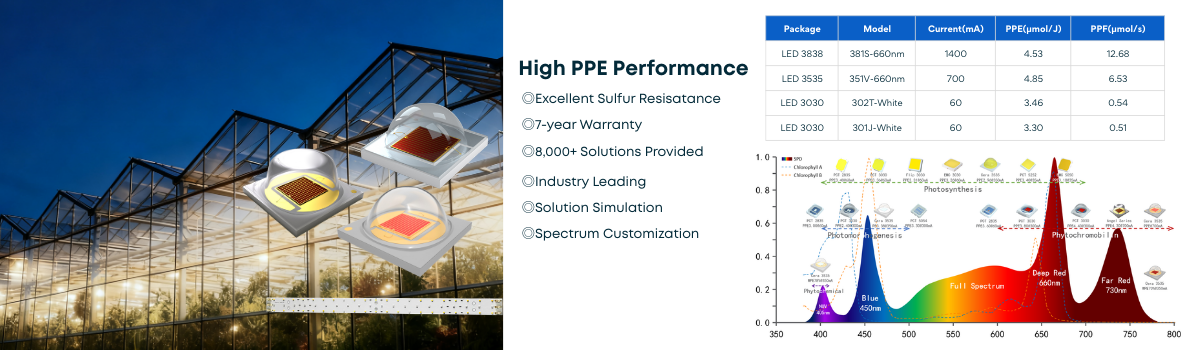
Ledestar presented high-PPE LED chips designed for horticulture applications, delivering strong performance in key wavelengths such as 450 nm blue light and 660 nm deep red light. These wavelengths play an essential role in photosynthesis and plant development.
By optimizing LED packaging and phosphor technology, Ledestar is able to produce LEDs that convert electrical energy into photosynthetically active photons more efficiently. For horticulture lighting manufacturers, higher PPE means more effective grow lighting systems and improved energy efficiency.
Zhaga Modules and Modular Lighting Design
Modular lighting design has become an increasingly important trend as manufacturers seek ways to simplify product development and improve compatibility between components. Zhaga standards provide a framework that allows LED light engines to be easily integrated into various luminaire designs.
At the exhibition, Ledestar introduced several Zhaga-compatible LED modules designed to support flexible fixture development. These modules provide reliable optical performance and thermal management while allowing lighting manufacturers to integrate standardized LED engines into their products.
This modular approach not only reduces development time but also provides greater flexibility in luminaire design, making it easier for lighting companies to respond to changing market demands.
Looking Ahead
The innovations presented at Light + Building 2026 reflect the continued evolution of LED technology. As the lighting industry moves toward higher efficiency, better spectral control, and more specialized applications, improvements at the LED chip level will remain a key driver of progress.
For Ledestar, the exhibition provided valuable opportunities to connect with global partners and demonstrate how advanced LED packaging technology can support the next generation of lighting systems. By continuing to focus on efficiency, reliability, and spectral engineering, the company aims to help lighting manufacturers create solutions that meet the growing demands of modern lighting environments.
Table of Contents