How Does Far Red 730nm Affect Plant Growth?
March 4, 2026
Read:889
Source: Ledestar
The Complete Science Behind 730nm LED in Horticulture
Far red light at 730nm has moved from being considered a secondary spectrum to becoming a strategic tool in advanced horticulture lighting systems. While traditional plant lighting has long focused on blue light at 450nm and red light at 660nm, modern research confirms that 730nm LED plays a critical regulatory role in plant morphology, flowering control, canopy architecture, and even photosynthetic efficiency under specific conditions.
Understanding how 730nm interacts with plant photoreceptors, how it influences phytochrome equilibrium, and how it can be applied in controlled environment agriculture (CEA) allows growers to design smarter and more profitable lighting strategies. This article explores the biological mechanisms, measurable data, crop responses, and practical integration methods of far red 730nm lighting.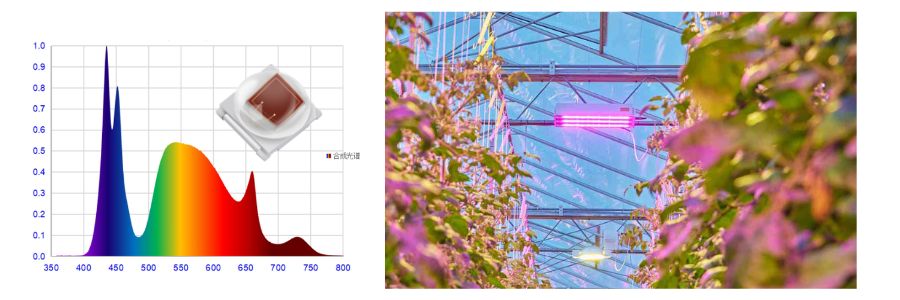
Key concept:730nm is not just a signal; it synergizes with red photons (660 nm) to boost photosynthetic efficiency via the Emerson enhancement effect, while also triggering morphological responses like leaf expansion and stem elongation.
1. What Is 730nm Far Red Light?
The 730nm wavelength sits just beyond the conventional photosynthetically active radiation (PAR) range of 400–700nm. Although it lies outside the traditional definition of PAR, far red light profoundly affects plant development through photomorphogenic regulation rather than direct chlorophyll absorption.
Plants contain specialized photoreceptors called phytochromes, which exist in two interconvertible forms. Red light around 660nm converts phytochrome into its active Pfr form, while far red light near 730nm converts it back to the inactive Pr form. The ratio between these two forms determines how a plant interprets its surrounding light environment. When exposed to higher proportions of 730nm LED radiation, plants perceive competition or canopy shade and adjust their growth strategy accordingly.
2. Phytochrome Photostationary State and Shade Avoidance
The balance between red and far red light determines the phytochrome photostationary state (PPS). In natural sunlight, the red-to-far-red ratio is typically around 1.2–1.5. Under canopy shade, this ratio can drop below 0.7 because upper leaves absorb red wavelengths while reflecting or transmitting far red light.
When plants detect increased 730nm LED exposure and a reduced red-to-far-red ratio, they activate shade avoidance responses. These responses are not random but highly regulated survival mechanisms. Internode elongation accelerates, leaves expand to capture more light, and in some long-day species, flowering is triggered earlier.
This response can be beneficial or problematic depending on crop type and cultivation goals. For example, increased elongation may improve light penetration in fruiting crops like tomatoes but may cause undesirable stretching in compact leafy greens.
3. Does 730nm LED Enhance Photosynthesis?
Although far red photons are less efficiently absorbed by chlorophyll, they participate in what is known as the Emerson Enhancement Effect. This phenomenon occurs when shorter wavelengths (such as red or blue light) are combined with far red light, resulting in higher overall photosynthetic efficiency than when either wavelength is applied independently.
Photosystem I preferentially absorbs far red wavelengths, while Photosystem II absorbs shorter red wavelengths. When both systems are excited simultaneously, electron transport efficiency increases, enhancing carbon assimilation. Studies have shown that adding 10–20 μmol·m⁻²·s⁻¹ of 730nm LED to a base PAR intensity of 400 μmol·m⁻²·s⁻¹ can increase biomass production by approximately 8–15%, depending on crop species and environmental conditions.
4. Quantified Growth Differences Under 730nm Supplementation
| Parameter | Standard Spectrum | + 730nm LED | Change |
|---|---|---|---|
| Total Biomass (g) | 128 | 146 | +14% |
| Leaf Area (cm²) | 1020 | 1185 | +16% |
| Stem Length (cm) | 17 | 21 | +24% |
| Flowering Time (Days) | 33 | 29 | -12% |
These figures illustrate that 730nm LED supplementation can significantly influence plant architecture and development speed. However, structural reinforcement and spectrum balancing are critical to prevent excessive stretching.
5. Growth Stage-Specific Application of 730nm LED
The effectiveness of far red lighting depends heavily on timing. During early vegetative growth, modest far red supplementation can enhance leaf expansion and canopy coverage. As plants transition into flowering, far red exposure becomes a powerful tool for photoperiod manipulation.
Some growers apply short pulses of 730nm LED at the end of the photoperiod. This “end-of-day far red” treatment rapidly shifts phytochrome equilibrium and simulates sunset conditions. In long-day plants, this technique can accelerate flowering and reduce production cycles by several days.
However, continuous high-intensity far red exposure throughout the full light cycle may lead to excessive elongation. Therefore, most professional lighting systems limit far red contribution to less than 10% of total photon flux density.
6. Crop-Specific Responses to 730nm LED
Different species respond uniquely to far red supplementation. Leafy greens such as lettuce often exhibit pronounced elongation and increased leaf expansion. Fruiting crops like tomatoes and peppers tend to benefit from improved canopy penetration and earlier fruit set. Ornamental species frequently show more uniform and accelerated flowering when exposed to 730nm LED.
This variability highlights the importance of spectral customization. A one-size-fits-all far red strategy rarely delivers optimal results across multiple crop categories.
7. Energy Efficiency and LED Technology Considerations
Modern 730nm LED chips achieve radiant efficiencies between 45–60%, depending on packaging technology and thermal management. Because far red is typically applied at lower photon densities compared to primary PAR lighting, its overall energy impact remains controlled while still producing measurable morphological benefits.
Advancements in chip design, including improved epitaxial structures and optimized phosphor-free emission for narrow-band output, have further enhanced the stability and lifespan of 730nm LED components in horticulture applications.
8. Strategic Integration into Commercial Lighting Systems
Integrating 730nm LED into horticultural lighting systems requires a spectrum-based approach rather than simply adding extra diodes. Successful strategies involve balancing blue, red, and far red wavelengths to maintain structural integrity while maximizing biomass production.
Greenhouse operations often use dynamic spectrum control systems that adjust far red output throughout the day. In vertical farms, programmable lighting recipes allow growers to fine-tune far red ratios according to growth stage and crop type. These precision lighting strategies are redefining the role of far red in commercial agriculture.
9. Common Mistakes When Using 730nm LED
Despite its advantages, improper use of 730nm LED can reduce crop quality. Overexposure may lead to weak stems and lower mechanical strength. Ignoring red-to-far-red ratios can disrupt photoperiod regulation. Additionally, failing to adjust nutrient management alongside morphological changes may limit the yield benefits of far red supplementation.
Careful calibration, real-time monitoring, and crop-specific experimentation remain essential for maximizing performance.
Conclusion: Why 730nm LED Is a Competitive Advantage
The integration of 730nm LED into horticultural lighting systems represents a shift from purely photosynthetic thinking to photobiological optimization. Far red light influences plant architecture, accelerates flowering, enhances canopy efficiency, and works synergistically with red light to improve overall photosynthetic performance.
When strategically applied with proper intensity control, balanced red-to-far-red ratios, and crop-specific timing, 730nm LED becomes more than an accessory wavelength—it becomes a precision spectrum tool that drives measurable yield gains, faster production cycles, and higher-quality plant development in modern controlled environment agriculture.
Table of Contents