Is Red Light Therapy The Same As Infrared
October 29, 2026
Read:10
Source: lideda
Red light therapy and infrared therapy are often discussed together because both use specific wavelengths of light to interact with the body. They are commonly found in skincare devices, wellness equipment, and photobiomodulation systems.
However, red light therapy is not exactly the same as infrared therapy. Red light uses visible wavelengths, while infrared therapy uses wavelengths beyond the visible spectrum.
Although both may be used in photobiomodulation, their penetration characteristics, biological interactions, and applications can differ.
Understanding these differences is important when choosing LED therapy devices or developing specialized LED solutions.
What Is Red Light Therapy?
Red light therapy is a non-invasive treatment approach that uses visible red light, typically between 620nm and 700nm, to stimulate biological responses in tissues.
Common wavelengths include:
630nm: Frequently used in skincare and cosmetic light therapy devices.
633nm: Studied for skin rejuvenation and certain dermatological applications.
660nm: Widely used in photobiomodulation research involving skin and superficial tissues.
Red light therapy is commonly investigated for improving skin appearance, supporting wound healing, and reducing certain types of inflammation.
Researchers believe that some effects may involve interactions with cellular photoacceptors, mitochondrial signaling, and downstream biological pathways. However, the precise mechanisms and clinical effectiveness vary by condition and treatment protocol.
What Is Infrared Therapy?
Infrared therapy uses infrared radiation, which has wavelengths longer than visible red light.
Infrared radiation is generally divided into three broad categories:
Infrared type | Approximate wavelength |
|---|---|
Near-infrared (NIR) | 700–1,400nm |
Mid-infrared (MIR) | 1,400–3,000nm |
Far-infrared (FIR) | 3,000nm–1mm |
The exact category boundaries can vary between technical standards.
Near-infrared LEDs, particularly 810nm, 830nm, and 850nm, are commonly used in photobiomodulation devices.
Far-infrared technology, meanwhile, is often associated with radiant heating systems and infrared saunas. These produce effects primarily through heat rather than the same light-based mechanisms proposed for red and near-infrared photobiomodulation.
Red Light Therapy vs Infrared Therapy: Key Differences
Feature | Red light therapy | Near-infrared therapy |
|---|---|---|
Typical wavelengths | 620–700nm | 700–1,400nm |
Visibility | Visible red | Mostly invisible |
Common LED wavelengths | 630nm, 660nm | 810nm, 830nm, 850nm |
Tissue penetration | Generally more superficial | Can reach deeper tissues |
Common research areas | Skin, superficial wound healing | Muscles, joints, deeper tissue applications |
Main mechanism | Photobiomodulation | Photobiomodulation |
Heat generation | Usually limited in LED devices | Usually limited in LED PBM devices |
Typical equipment | LED masks, therapy panels | NIR LED panels, therapeutic devices |
Near-infrared light does not always penetrate farther under every condition. Actual penetration depends on wavelength, tissue composition, scattering, absorption, and device design.
How Do Red Light and Infrared Therapy Work?
Both red and near-infrared photobiomodulation use light energy to influence biological processes.
One proposed mechanism involves the absorption of photons by cellular components, including mitochondrial photoacceptors. This may influence cellular signaling, oxidative balance, and inflammatory responses.
However, the biological effects are not determined by wavelength alone.
Treatment outcomes also depend on:
Irradiance, measured in mW/cm².
Energy density, measured in J/cm².
Treatment duration and frequency.
Distance between the device and skin.
Target tissue and treatment condition.
Higher light intensity does not necessarily produce better results. Photobiomodulation can exhibit a biphasic dose response, meaning excessive exposure may reduce or alter the desired biological effect.
Which Penetrates Deeper: Red Light or Infrared?
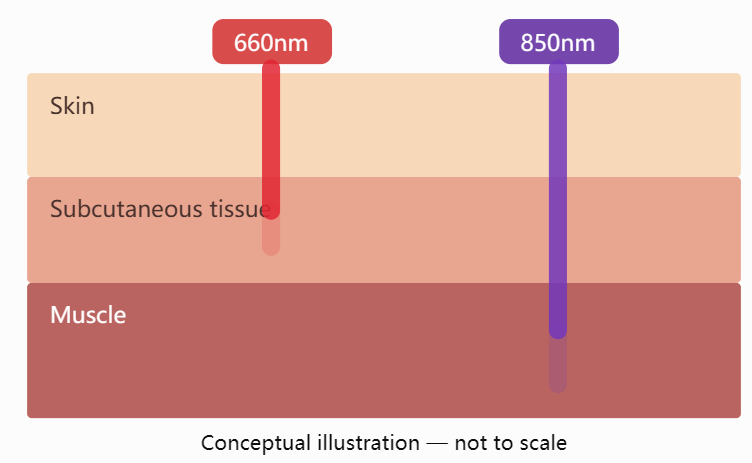
Near-infrared light generally has greater potential to reach deeper tissues than visible red light, although penetration varies considerably with the tissue and wavelength.
Red light is frequently selected for applications focused on skin and superficial tissues.
Near-infrared wavelengths such as 810nm and 850nm are often studied for deeper tissue applications, including muscle and joint-related conditions.
However, deeper light penetration does not automatically establish greater therapeutic effectiveness.
Benefits and Applications of Red Light Therapy
Skin Rejuvenation
Red light therapy has been studied for improving the appearance of fine lines, skin texture, and certain signs of photoaging.
Some clinical studies report modest improvements, although results depend on the device and treatment schedule.
Wound Healing
Red light photobiomodulation is being investigated as a supportive approach for wound healing. Evidence varies by wound type, and it should not replace established medical wound care.
Inflammation and Skin Recovery
Certain red light treatment protocols may influence inflammatory signaling and tissue repair. More research is needed to determine optimal treatment parameters for individual conditions.
Benefits and Applications of Near-Infrared Therapy
Muscle Recovery
Near-infrared photobiomodulation is studied for muscle soreness, exercise recovery, and performance-related outcomes.
Some studies suggest potential benefits, but the findings are not consistent across all protocols.
Joint Discomfort
Near-infrared light has been investigated for managing symptoms associated with some musculoskeletal conditions.
It may provide relief in certain settings, although it is not a proven replacement for conventional treatment.
Deeper Tissue Research
Near-infrared wavelengths are also used in research involving nerve tissue, tissue repair, and other specialized applications. Many of these uses remain investigational.
Can You Use Red Light and Infrared Therapy Together?
Yes. Many modern photobiomodulation devices combine visible red and near-infrared LEDs.
For example, a therapy panel may contain both 660nm red LEDs and 850nm near-infrared LEDs.
Combining wavelengths allows designers to deliver light with different tissue absorption and penetration characteristics.
However, combining red and near-infrared light does not guarantee better outcomes than using a single wavelength. Clinical benefits depend on the treatment indication and dosing protocol.
Which LED Wavelength Is Best for Light Therapy?
The appropriate wavelength depends on the intended application.
Wavelength | Light type | Common research or device application |
|---|---|---|
630nm | Visible red | Skincare and superficial tissue |
633nm | Visible red | Cosmetic dermatology |
660nm | Visible red | Skin and wound-related photobiomodulation |
810nm | Near-infrared | Muscle, nerve, and deeper tissue research |
830nm | Near-infrared | Photobiomodulation and tissue recovery |
850nm | Near-infrared | Muscle and joint-related devices |
940nm | Near-infrared | Optical sensing and specialized medical equipment |
940nm is widely used in infrared sensing systems, but it is less established than several shorter near-infrared wavelengths in mainstream photobiomodulation research.
For LED device manufacturers, wavelength selection should be based on optical measurements, application requirements, thermal performance, and relevant clinical evidence.
Are Red Light and Infrared Therapy Safe?
Red and near-infrared LED devices are generally well tolerated under appropriately controlled exposure conditions, but safety depends on the device.
Potential concerns include eye exposure, excessive irradiance, heat buildup, and use in individuals with certain photosensitive conditions or medications.
Infrared light can present an eye hazard even when it cannot be seen. Users should follow device-specific eye protection instructions, and manufacturers should evaluate applicable photobiological safety standards such as IEC 62471.
Medical treatment decisions should be discussed with a qualified healthcare professional, particularly when treating a diagnosed condition.
Frequently Asked Questions
Is red light therapy infrared?
No. Red light therapy uses visible red wavelengths, whereas infrared therapy uses wavelengths beyond visible red. Some therapy devices combine both.
Is 850nm infrared the same as 660nm red light?
No. 660nm is visible red light, while 850nm is near-infrared. They have different optical characteristics and tissue interactions.
Is infrared therapy better than red light therapy?
Neither is universally better. Red light is commonly used for superficial skin applications, while near-infrared light is frequently investigated for deeper tissues.
Does red light therapy produce heat?
LED-based red light therapy generally produces less heating than thermal infrared devices. However, high-power devices can still warm the skin.
Can infrared therapy help with wrinkles?
Some near-infrared photobiomodulation studies have investigated skin appearance, but visible red light has a more established role in many cosmetic LED treatment protocols. Results are variable.
Can I use red light therapy every day?
Appropriate treatment frequency depends on the device, light dose, and intended application. Daily use is not automatically necessary or beneficial.
Red light therapy and infrared therapy are related, but they are not identical.
Red light therapy typically uses visible wavelengths between 620nm and 700nm, making it a common choice for skincare and superficial tissue applications.
Near-infrared therapy uses longer wavelengths, including 810nm, 830nm, and 850nm, which may reach deeper tissues and are investigated for a wider range of photobiomodulation applications.
For LED manufacturers, engineers, and medical device developers, understanding the differences between red and near-infrared wavelengths is essential for designing appropriate optical systems.
Ultimately, the best wavelength depends on the intended treatment, device performance, light dosage, safety requirements, and available scientific evidence.
Table of Contents