What Is The Function of 660nm LED In Horticulture Lighting?
January 8, 2026
Read:795
Source: Ledestar
The Function of 660nm LED in Horticulture Lighting: A Key to Optimizing Plant Growth
Abstract: The precise application of light spectra has become a cornerstone of modern horticulture, with Light-Emitting Diode (LED) technology enabling unprecedented control over plant development. This article examines the pivotal role of the 660nm wavelength within the red spectrum. We detail how 660nm LED light functions as the primary driver for photosynthetic efficiency and a crucial regulator of plant morphology through the phytochrome system. By optimizing these two fundamental processes, 660nm light directly enhances crop yield, quality, and production efficiency in controlled environment agriculture.
1. The Photobiological Basis of 660nm Efficacy
The significance of 660nm light in plant growth is not arbitrary but is fundamentally rooted in plant photoreceptor chemistry. Its unique value stems from a precise alignment with the absorption peaks of two critical pigment systems: chlorophyll and phytochrome.
Chlorophyll a and b, the engines of photosynthesis, exhibit a pronounced absorption maximum in the deep red region of the spectrum, precisely around 660-680nm. Photons emitted at this wavelength are absorbed with exceptional efficiency, directly fueling the photochemical reactions that convert light energy into chemical energy (ATP and NADPH). Consequently, 660nm light delivers superior Photosynthetic Photon Efficacy (PPE), providing the most photosynthetic "value" per unit of light energy invested, making it indispensable for biomass accumulation.
Simultaneously, 660nm light is the key activator of the phytochrome photoreceptor system, which governs how plants interpret their light environment. Phytochrome exists in two interconvertible forms: the red-absorbing Pr form (peak ~660nm) and the far-red-absorbing Pfr form (peak ~730nm). Exposure to 660nm light establishes a high ratio of Pfr to Pr. This specific Pfr:Pr ratio acts as a signal, indicating to the plant that it is in an open, high-light environment. This triggers a suite of desirable morphological responses, including compact internodal growth (preventing legginess), enhanced leaf expansion, and the promotion of flowering in many species.
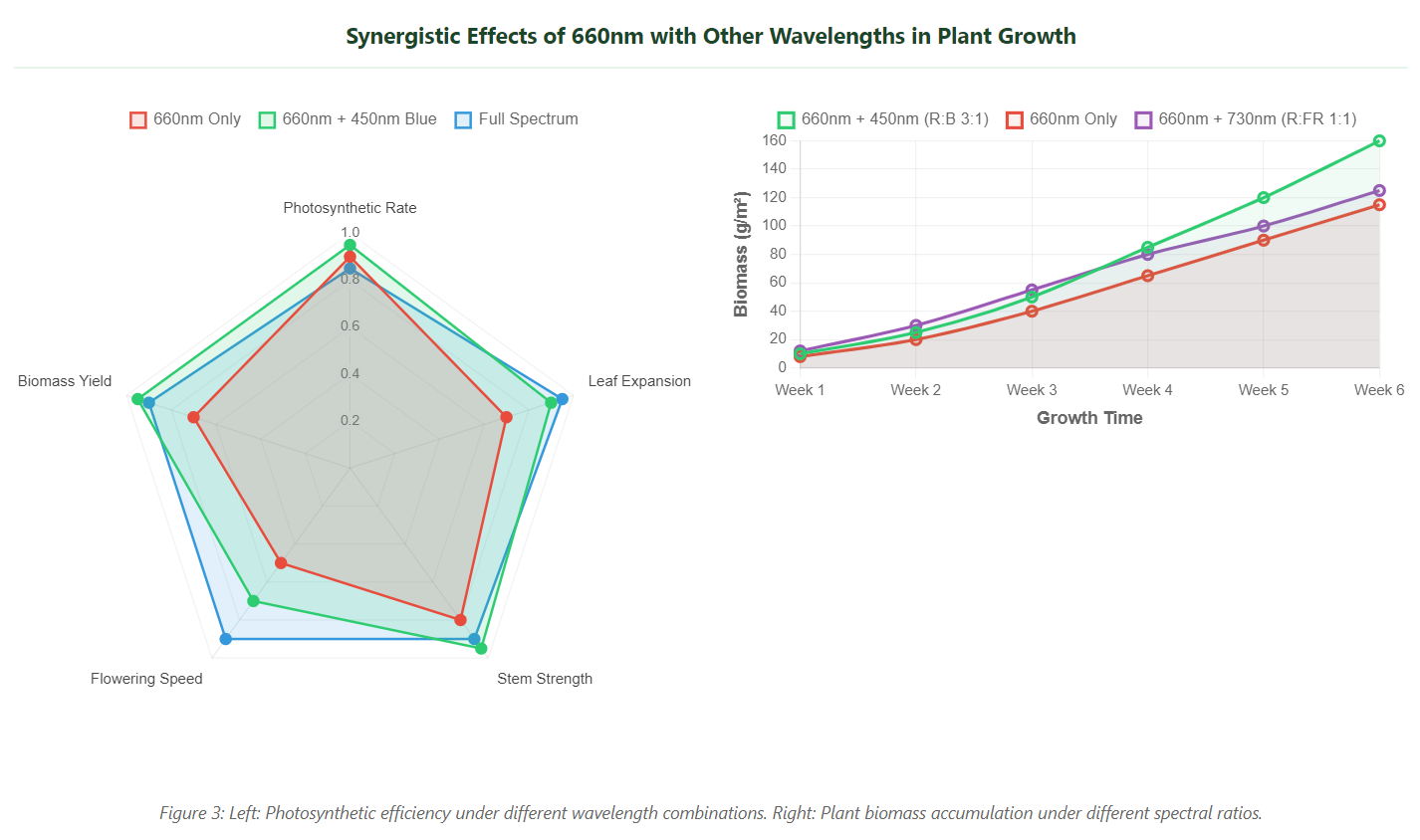
2. Core Agronomic Benefits and Functional Outcomes
Integrating 660nm LEDs into horticulture lighting regimens translates photobiological principles into tangible agricultural benefits. The most direct impact is on photosynthetic rate and biomass production. A strong 660nm spectral component ensures the photosynthetic machinery operates at peak capacity, directly accelerating growth cycles and increasing fresh weight yield, particularly for leafy greens, herbs, and microgreens in vertical farms and greenhouses.
Beyond pure growth, the strategic application of 660nm light offers profound control over plant architecture and development timing. By maintaining a high Pfr:Pr ratio, growers can produce sturdier, more compact seedlings and ornamental plants, significantly reducing the need for chemical growth retardants. This control extends to reproductive timing; for photoperiod-sensitive crops, 660nm light can be used to precisely induce and synchronize flowering, improving crop uniformity and scheduling. Furthermore, while other wavelengths (e.g., blue, UV) often stimulate the production of secondary metabolites like antioxidants, a robust 660nm foundation ensures the plant has the necessary photosynthetic capacity and biomass to allocate resources into these valuable compounds without sacrificing yield.
Physiological Responses of Key Crops to 660nm-Rich Illumination
| Crop Type | Primary Benefit of 660nm LED | Typical Application Phase |
|---|---|---|
| Leafy Greens (Lettuce, Kale) | Enhances photosynthesis, leaf expansion, and biomass accumulation | Full growth cycle |
| Tomato / Pepper Seedlings | Promotes compact growth and strong stem development | Seedling and early vegetative stage |
| Ornamental Flowers | Stimulates flowering initiation and uniform bloom timing | Photoperiod induction stage |
| Medicinal Plants | Improves flower formation and overall photon utilization | Flowering stage (combined spectrum) |
| Berry Crops | Supports fruit set, sugar accumulation, and yield stability | Flowering to fruit development |
| Microgreens & Herbs | Accelerates cotyledon expansion and fresh weight gain | From germination to harvest |
3. Strategic Integration within a Broader Light Spectrum
The function of 660nm light is maximized not in isolation, but through its synergistic interplay with other wavelengths within a comprehensive spectral recipe. Its most fundamental partnership is with 450nm blue light. Blue light complements red absorption by chlorophyll, activates additional photoreceptors like cryptochromes (regulating stomatal opening, phototropism), and works in concert with 660nm to ensure balanced, compact morphology. A typical vegetative growth spectrum features a red-to-blue ratio between 3:1 and 5:1.
A more advanced strategic relationship exists with 730nm far-red light. The biological effect of 660nm is dynamically modulated by the presence of far-red. By deliberately adding 730nm light, growers can lower the Pfr:Pr ratio, mimicking shaded conditions. This can be leveraged to promote stem elongation where desirable (e.g., in cut flowers), increase leaf area to enhance light interception, or trigger specific flowering responses in certain plants. This precise manipulation of the red to far-red ratio is a powerful tool for advanced crop steering.
Even in broad-spectrum "white" LED fixtures, the supplementation with dedicated 660nm LEDs is often critical. Many white LEDs have a spectral deficit in the deep red region. Augmenting them with high-output 660nm diodes ensures the spectrum meets the full photosynthetic and photomorphogenic demands of the plant, combining the visual benefits of white light with the physiological potency of targeted deep red.
4. Conclusion and Future Directions in Application
The 660nm LED stands as a fundamental pillar of modern horticulture lighting, uniquely capable of optimizing both the energy capture (photosynthesis) and developmental programming (photomorphogenesis) of plants. Its dual role makes it essential for achieving efficient, predictable, and high-quality crop production. Future advancements will likely focus on greater integration and dynamism. The development of intelligent lighting systems that modulate 660nm intensity in real-time based on crop phase, environmental data, or desired plant responses represents the next frontier. Concurrently, ongoing research into crop-specific spectral recipes will further refine the optimal placement and proportion of 660nm light within the spectrum for each species and production goal. As LED efficiency continues to improve, the centrality of the 660nm wavelength in enabling sustainable, precision horticulture will only become more pronounced.
Table of Contents