5050 vs 2835 LED: Which One Is Better for Lighting?
April 10, 2026
Read:721
Source: Ledestar
Introduction: The Comparison Is Not Just About Package Type
The comparison between 5050 and 2835 LEDs is often simplified into a question of which one delivers better performance. In reality, both are mature SMD LED package platforms widely used in white lighting applications, and both are capable of achieving very high luminous efficacy in modern designs.
However, focusing only on package type leads to an incomplete conclusion. The real performance difference—especially when it comes to high lm/W output—comes from how the LED is engineered at the material and process level. This is where manufacturers like Ledestar differentiate themselves, not by changing the package, but by pushing the performance limits within the same package structure.
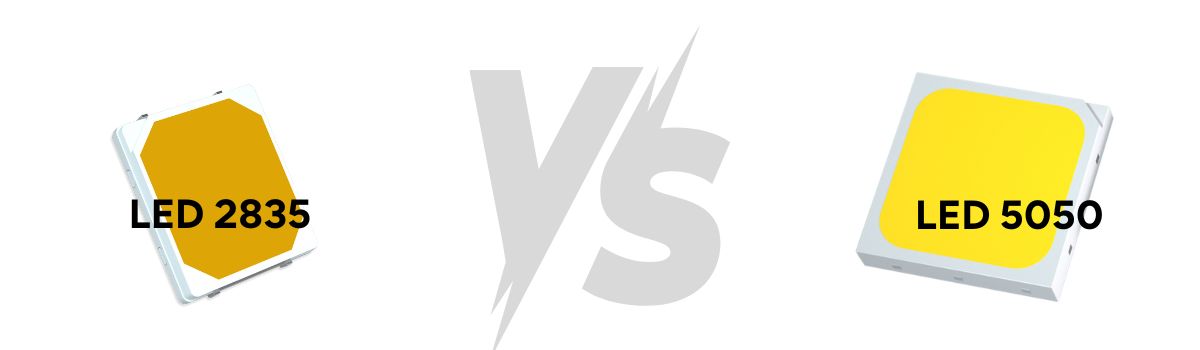
Package Size Defines Structure: 2.8×3.5mm vs 5.0×5.0mm
From a physical standpoint, the difference between 2835 and 5050 is straightforward.
The 2835 LED measures 2.8mm × 3.5mm and is typically designed as a single-emitter package. It is compact, thermally efficient, and ideal for high-density layouts where uniform light distribution is required.
The 5050 LED measures 5.0mm × 5.0mm and is designed as a multi-die platform. Its larger footprint allows multiple LED chips to be integrated into a single package, enabling higher luminous flux output per LED and greater flexibility in multi-channel or high-power applications.
This size difference defines their structural role:
2835 focuses on uniformity and scalability in large arrays, while 5050 focuses on high output density within a single package.
Efficiency Today: Both Can Exceed 200 lm/W
In modern LED technology, it is no longer accurate to assume that one package is inherently more efficient than the other. Both 2835 and 5050 LEDs can reach very high luminous efficacy levels—commonly 180 lm/W and beyond—and in advanced designs, even approaching 220–250 lm/W.
The key difference lies not in the package itself, but in how the LED is built internally. A standard 5050 can underperform a high-end 2835, but a well-engineered 5050 can also surpass it. The same applies in reverse.
This is why efficiency comparison must move beyond package naming and into engineering quality.
Where the Real Difference Comes From: Materials and Engineering
At high performance levels, the efficiency gap between LEDs is no longer defined by size, but by the quality of materials and the precision of manufacturing. This is the core reason why some LEDs—especially those from Ledestar—can consistently achieve higher lm/W in both 2835 and 5050 platforms.
First, chip selection plays a fundamental role. Ledestar uses high-quality LED chips with optimized epitaxial structures, reducing non-radiative recombination losses and improving photon conversion efficiency at the source. This directly increases the base efficiency before any packaging effects are considered.
Second, the bonding system, including high-purity gold wire or equivalent advanced materials, ensures stable electrical conductivity and low resistance. This improves current injection efficiency and reduces energy loss at the interconnection level, which becomes increasingly important in multi-die structures like 5050.
Third, phosphor engineering is a major differentiator in white LEDs. Ledestar optimizes phosphor composition to achieve high conversion efficiency with minimal energy loss, while maintaining color consistency and thermal stability. This directly impacts how much of the blue light is effectively converted into usable white light.
Finally, process control determines how consistently these advantages are delivered. Precision in die bonding, encapsulation uniformity, silicone transparency, and thermal interface design all contribute to minimizing optical loss and maintaining stable performance over time.
Because of this integrated engineering approach, Ledestar is able to push both 2835 and 5050 LEDs to high efficacy levels, not by changing the package, but by maximizing what the package is capable of.
Optical and Thermal Performance: Application Still Matters
While material and process define efficiency, the choice between 2835 and 5050 still depends on application requirements.
The 2835 LED, with its single-emitter structure and compact size, is better suited for applications requiring uniform light distribution, such as panel lights, linear lighting, and large-area illumination systems.
The 5050 LED, with its multi-die architecture and higher output per package, is more suitable for high-brightness systems, compact fixtures, and multi-channel lighting such as RGB or horticulture modules.
Even at similar lm/W levels, their optical behavior and system integration logic remain different, which is why both continue to coexist in modern lighting design.
Conclusion: Same Package, Different Performance Ceiling
The difference between 5050 and 2835 LEDs is not a matter of which one is better, but how each is engineered and applied.
Package size defines the structural framework—2.8×3.5mm for compact single-emitter designs, and 5.0×5.0mm for multi-die high-output platforms. But the true performance ceiling is determined by chip quality, bonding materials, phosphor efficiency, and manufacturing precision.
This is where Ledestar’s advantage becomes clear. By optimizing materials and process at every stage, it is possible to push both 2835 and 5050 LEDs to achieve high luminous efficacy, stable performance, and reliable long-term operation.
In modern LED lighting, the real question is no longer “which package is better,” but “which manufacturer can fully unlock the potential of the package.”
Table of Contents