What Is a 365nm UV LED Chip and How Does It Work?
April 21, 2026
Read:1415
Source: Ledestar
365nm UV LED Chip: The Complete Technical Guide
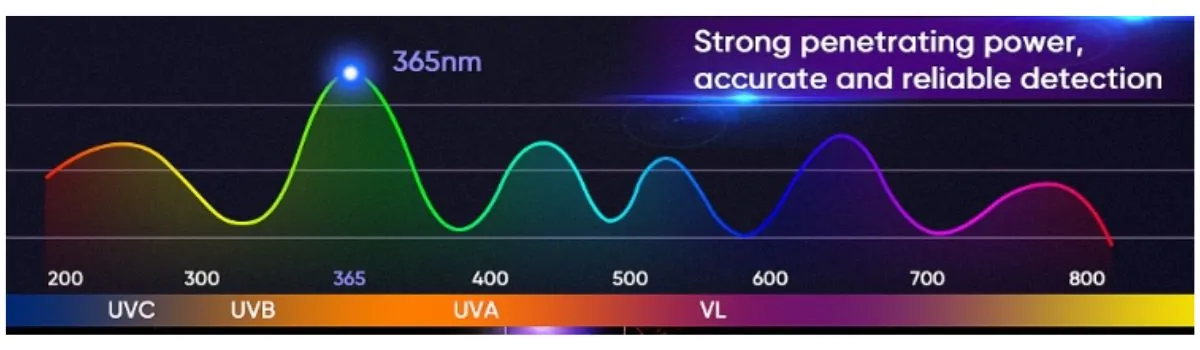
The 365nm UV LED chip has become the cornerstone of modern ultraviolet technology. As a precise peak wavelength in the UVA spectrum, 365nm LED chips deliver exceptional performance in fluorescence excitation, UV curing, disinfection, forensic detection, and industrial applications. This guide provides in-depth technical insights, performance data, real-world case studies, and practical information focused specifically on 365nm UV LED chips.
What Is a 365nm UV LED Chip?
A 365nm UV LED chip is a specialized semiconductor device designed to emit ultraviolet light with a dominant wavelength of 365 nanometers. These chips are predominantly fabricated using AlGaN or InGaN-based epitaxial layers, typically grown on sapphire or silicon carbide substrates. They efficiently convert electrical energy into narrow-band UVA radiation, delivering high performance and reliability.
Compared to conventional mercury vapor lamps, 365nm UV LED chips provide several advantages, including instant on/off functionality, mercury-free operation, an extended lifespan ranging from 20,000 to 50,000+ hours, and precise spectral output control. Advanced high-power variants of these chips can achieve radiant flux levels between 0.5W and over 3W per chip. Typically, their forward voltage ranges from 3.2V to 3.8V, and they operate at drive currents between 350mA and 1.5A, depending on the specific package design.
Technical Specifications and Performance Data of 365nm UV LED Chips
High-quality 365nm UV LED chips typically feature the following key parameters:
- Peak Wavelength: 365 ± 5 nm (narrow FWHM usually 8–15 nm)
- Radiant Flux: 800–2500 mW at 700–1000 mA (depending on chip size and binning)
- Forward Voltage: 3.4–3.7V typical
- Viewing Angle: 120° or 60° (lens-dependent)
- Thermal Resistance: 2.5–6 °C/W for high-power variants
- Lifetime: L70 > 25,000 hours at Tj 85°C
Performance data from top manufacturers indicates that the latest 365nm UV LED chips have reached a wall-plug efficiency (WPE) of 40–55%, marking a notable improvement over previous models. For curing applications, these 365nm chips deliver a superior depth of cure compared to 395nm or 405nm chips, especially when paired with conventional photoinitiators like Irgacure 184 or TPO.
Key Applications of 365nm UV LED Chips
1. UV Curing Systems
Ultraviolet (UV) LED chips with a 365nm wavelength are extensively utilized in applications such as industrial adhesive curing, 3D printing resins, coatings, and inkjet printing. This widespread use stems from the fact that many traditional photoinitiators are specifically designed to perform optimally at this wavelength, enabling quicker and more efficient polymerization processes. Studies indicate that systems centered around 365nm light consistently achieve conversion rates of 98–99% in thicker layers up to 5mm. In contrast, 395nm chips often struggle to exceed a 70% conversion rate under identical conditions.
2. Forensic and Security Applications
UV LED chips with a 365nm wavelength are highly effective in forensic lighting applications. This specific wavelength enhances the fluorescence of bodily fluids, fluorescent powders, and security inks, making them easily detectable. Due to their superior radiant intensity and low visible light interference, these chips are a favored choice for law enforcement agencies, commonly integrated into portable flashlights and crime scene illumination tools.
3. Disinfection and Photochemistry
While not as potent as UVC in causing direct DNA damage, 365nm UV LED chips have shown effectiveness in inactivating certain bacteria and viruses by generating reactive oxygen species. Research indicates that high-intensity 365nm LED arrays can achieve up to an 8-log reduction of E. coli in liquid media with doses approximately around 139 J/cm².
4. Fluorescence Detection and Analytical Instruments
In laboratory settings, 365nm UV LED chips are utilized as excitation sources for the detection of proteins, vitamins, aflatoxins, and minerals. Their precise emission band significantly reduces background noise, enhancing accuracy in fluorescence spectroscopy and microscopy applications.
Real-World Case Studies
Case Study 1: Industrial Adhesive Curing in Electronics Manufacturing
A leading electronics manufacturer upgraded their conformal coating process by switching from mercury lamps to 365nm UV LED chip arrays. This transition cut curing time from 45 seconds to just 12 seconds per board, reduced energy usage by 68%, and completely eliminated mercury waste. The change also boosted production throughput by 35%, with consistent cure depth confirmed through detailed cross-section analysis.
Case Study 2: Forensic Evidence Detection in Major Crime Investigation
In a prominent sexual assault investigation, authorities utilized a 365nm UV LED chip-based flashlight to meticulously examine a hotel room. This advanced tool revealed fluorescent semen stains on the bedding and carpet that were invisible to the naked eye, enabling precise DNA collection. The recovered evidence conclusively connected the suspect to the crime scene, playing a crucial role in securing a conviction. The 365nm UV technology offered sharp contrast while ensuring the evidence remained uncontaminated by chemicals.
Case Study 3: Nail Gel Curing in Professional Salons
Professional UV/LED nail lamps equipped with high-power 365nm chips successfully cure gel polish within 45 to 60 seconds. Client feedback highlights extended wear times of up to 21 days and a reduction in allergic reactions when compared to older 395nm-dominant models. This improvement is attributed to the more thorough curing of the base layer.
Advantages of 365nm UV LED Chips Over Other Wavelengths
365nm UV LED chips offer several distinct advantages:
- Optimal match for traditional photoinitiators (better depth of cure)
- Stronger fluorescence excitation than 395nm or 405nm
- Lower eye and skin hazard compared to UVC
- Higher radiant efficiency in many curing formulations
- Minimal visible light output (true blacklight effect)
Safety Considerations for 365nm UV LED Chips
While 365nm UV LED chips are safer compared to shorter UV wavelengths, it is crucial to take proper precautions when handling them. Adhere to the ACGIH Threshold Limit Values by ensuring a maximum irradiance of 1.0 mW/cm² for exposure durations exceeding 1000 seconds and a total radiant exposure of no more than 1.0 J/cm² for shorter periods. Always wear UV-blocking eyewear and minimize direct skin exposure during use and testing.
Future Trends in 365nm UV LED Chip Technology
Manufacturers are making ongoing advancements in chip efficiency, thermal management, and power density. The latest 365nm UV LED chips are anticipated to achieve radiant flux levels surpassing 4W per chip, coupled with wall-plug efficiencies of more than 60%. These improvements are largely driven by growing applications in areas such as medical phototherapy, water quality monitoring, and high-precision 3D printing, which continue to inspire innovation in the design of 365nm UV LED chips.
FAQ – Frequently Asked Questions About 365nm UV LED Chips
Conclusion
The 365nm UV LED chip represents a mature yet continuously evolving technology, delivering outstanding performance across numerous high-value applications. Its precise wavelength, high efficiency, and reliable operation make it a preferred solution for experts in areas like UV curing, forensics, analytical sciences, and diverse industrial processes.
Gaining a solid understanding of the technical specifications and real-world performance of 365nm UV LED chips allows for more informed equipment choices, enhanced system design, and improved safety in applications that demand reliable, high-quality UVA output.
Table of Contents