2835 vs 5050 LED: What’s the Real Difference and Which Should You Choose?
December 8, 2025
Read:1343
Source: Ledestar
2835 vs 5050 LED: What’s the Real Difference and Which Should You Choose?
In the fast-evolving LED lighting industry, selecting the right LED chip is one of the most critical design choices for manufacturers, lighting engineers, and OEM solution providers. Among all SMD LED packages, 2835 LED and 5050 LED remain the two most widely used and highly discussed chip types due to their versatility, cost-performance balance, and ability to support applications ranging from indoor panels to high-brightness outdoor fixtures. Although both chip types may appear similar at first glance—each being a surface-mount LED with options for high efficacy, high CRI, or horticulture-specific wavelengths—their internal structures, optical performance, thermal behavior, and application suitability differ significantly. Understanding these differences is essential for engineers choosing the most efficient, cost-effective, and reliable lighting solution. This article provides an in-depth scientific comparison of 2835 vs 5050 LED chips, including package structure, luminous flux, lm/W efficiency, current capability, thermal resistance, color stability, multi-die configurations, horticulture wavelengths, and bill-of-materials implications for commercial production.

Package Structure and Physical Differences Between 2835 and 5050 LEDs
The most fundamental difference between 2835 and 5050 LEDs begins with their package dimensions and internal architecture. The numbers refer to the physical size: a 2835 LED measures 2.8 × 3.5 mm, while a 5050 LED measures 5.0 × 5.0 mm, nearly triple the footprint. This enlarged package gives 5050 LEDs significantly more internal space for multiple LED dies, typically supporting dual-die or tri-die architectures, allowing white light mixing (RGB, RGBW, or tunable white), and enabling higher overall luminous flux. In contrast, the 2835 package is streamlined for single-die high-efficiency white LEDs, optimized for maximum lm/W output with minimal heat generation and reduced forward current requirements.
From a packaging standpoint, the 2835 LED often uses a flip-chip or MCPET reflective chamber to maximize optical extraction. The 5050 package, however, frequently contains separate die cavities for RGB configuration or a larger cavity for high-power white applications. The larger physical size of 5050 LEDs inherently contributes to higher heat dissipation capacity, but because they hold multiple dies, the actual thermal load per die can be greater. The thermal resistance for a typical 2835 LED ranges between 8–15°C/W, whereas for a 5050 LED thermal resistance can be between 10–20°C/W depending on configuration.
Luminous Efficacy Comparison (lm/W)
One of the most striking differences between 2835 and 5050 LEDs is luminous efficacy, measured in lumens per watt (lm/W). The 2835 LED package was engineered specifically for high efficiency in general lighting applications, and many advanced 2835 LEDs can reach 200–240 lm/W, with premium solutions (including top-tier suppliers such as Nichia, Samsung, and Ledestar) even approaching 250 lm/W in laboratory or optimized bin conditions. The 2835’s high-performance thermal path, compact phosphor coating, and reduced forward current design work together to push efficacy to extremely high levels.
In comparison, most 5050 LEDs have efficacy in the range of 200-250 lm/W when used as single-color white LEDs,high-end manufacturers have pushed this above 240 lm/W for outdoor lighting applications by using multi-die high-efficiency white configurations. However, once RGB or RGBW mixing is involved, efficacy drops significantly because colored dies inherently produce fewer lumens per watt. Red dies typically operate at 20–60 lm/W, green dies at 60–120 lm/W, and blue dies at 30–60 lm/W. Therefore, a 5050 RGB LED cannot match the lm/W efficiency of a single-die 2835 LED engineered exclusively for white illumination
Forward Current and Power Handling: Why 5050 LEDs Support Higher Power
Current handling capacity is another dimension that separates 2835 from 5050 LED architectures. A typical 2835 LED runs at 20–60 mA, and high-power versions can handle 120–200 mA, although operating at higher currents reduces efficacy. In contrast, a 5050 LED—especially one with multiple dies—can operate at 150–500 mA total forward current while maintaining acceptable thermal performance. Because the 5050 package is physically larger, heat dissipation is distributed across a broader substrate surface, reducing localized heat concentration.
From a power perspective, 2835 LEDs are commonly available in 0.2 W, 0.5 W, and 1.0 W versions, while 5050 LEDs are typically 0.5 W, 1.0 W, 1.5 W, or 3.0 W 5.0W depending on die configuration and the bracket material. For manufacturers designing high-power LED modules, 5050 LEDs provide more robust headroom for driving the LEDs at higher currents without risking overheating or thermal degradation.
Thermal Management and Reliability Differences
Thermal stability is critical for long-term LED performance, particularly for outdoor lighting where temperature extremes can significantly affect lumen maintenance and chromaticity shift. Because 2835 LEDs operate at lower current levels and have inherently high optical efficiency, they generate less heat per lumen. This contributes to improved LM-80 performance, longer L70 lifetimes, and reduced phosphor degradation. Many premium 2835 LEDs demonstrate excellent lumen maintenance, retaining over 90% brightness after 10,000–12,000 hours at 55°C junction temperature.
5050 LEDs, although effective in managing heat due to their larger footprint, may exhibit faster thermal degradation when driven at high currents or when used in multi-die RGB/W configurations. Combining multiple dies increases both thermal density and the complexity of managing color stability. However, high-end 5050 LEDs designed for outdoor and industrial lighting often integrate advanced thermal pads and optimized thermal conductive substrates, enabling them to reach 50,000–100,000 hour lifetimes under controlled thermal conditions.
Color Rendering, CCT Stability, and Optical Quality
Color performance—particularly CRI (Color Rendering Index), R9 saturated red enhancement, and long-term chromaticity stability—varies between the two packages based on phosphor application and die flexibility. The 2835 LED package is optimized for uniform phosphor coating, allowing manufacturers to deliver consistent CRI 80, CRI 90, or CRI 95 performance with precise CCT control from 2700K to 6500K. In environments such as retail, office lighting, and residential applications, uniformity and consistency of color are more important than raw lumen output, making the 2835 package more favorable.
The 5050 LED, especially RGB/RGBW, offers superior flexibility for dynamic lighting, tunable white systems, architectural lighting, and entertainment lighting. With multiple independent dies, a 5050 RGB LED can generate millions of color combinations, enabling full-spectrum lighting control. However, RGB mixes inherently struggle with color stability under high thermal load, and precise color calibration requires complex control algorithms to maintain consistent hue and saturation.
Horticulture Lighting: Which Chip Performs Better?
For horticultural lighting, both 2835 and 5050 LEDs have unique advantages. The 2835 LED is dominant in high-efficacy white spectrum horticulture fixtures, especially full-spectrum 3000–5000K solutions and 5000K + 660nm blended spectra. The high lm/W of 2835 white LEDs directly translates into higher PPE (Photosynthetic Photon Efficacy), often achieving 2.7–3.2 μmol/J.
Meanwhile, 5050 LEDs excel in high-power 660nm deep red and 450nm blue applications, particularly when maximum photon density is required in compact areas. Multi-die 5050 horticulture LEDs often outperform single-die solutions in raw PPF output due to their ability to integrate more active area into one package. However, thermal management becomes more critical in 5050 systems, and proper PCB substrate selection (such as aluminum MCPCB or copper-core substrates) is essential.
Application Suitability: Where Each LED Type Performs Best
Best Applications for 2835 LEDs
Indoor commercial lighting
Panel lights, troffers, and downlights
Linear lights and strip lights requiring high lm/W
Full-spectrum horticulture lights
Energy-efficient fixtures targeting DLC or ERP certifications
High-density LED arrays requiring uniform distribution
Best Applications for 5050 LEDs
High-brightness outdoor lights (floodlights, street lights, stadium lights)
RGB / RGBW decorative lighting
LED strips requiring multiple colors per chip
Automotive ambient lighting and signal lights
Entertainment, stage, and architectural lighting
High-power horticulture lighting requiring strong red/blue intensity
Cost, Manufacturing Efficiency, and BOM Considerations
From a manufacturing perspective, 2835 LEDs are more cost-effective due to:
Lower packaging cost
Higher lm/W efficiency leading to fewer LEDs per fixture
Lower thermal management costs
Faster SMT assembly due to smaller footprint
On the other hand, 5050 LEDs can reduce BOM in high-power designs because fewer LED packages are needed to achieve a certain lumen level. RGB/RGBW 5050 LEDs also reduce the number of SKUs required for multi-color systems by integrating multiple dies into a single package.
However, 5050 LEDs require more robust PCBs, thicker copper traces, and more advanced thermal design, potentially increasing manufacturing costs on the system level.
Data Comparison Table: 2835 vs 5050 LED
 | 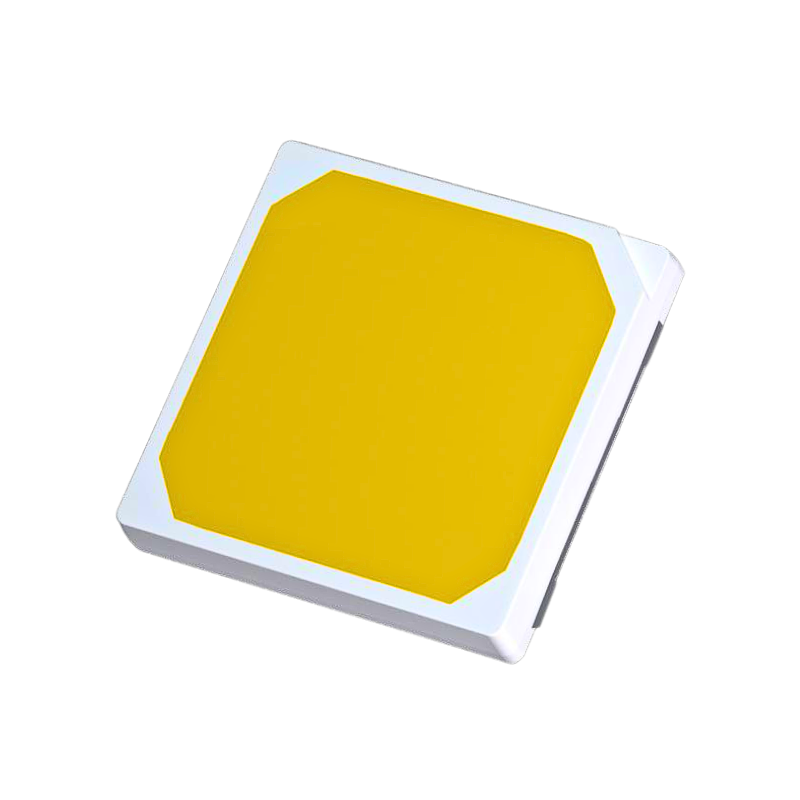 | |
|---|---|---|
| Specification | 2835 LED | 5050 LED |
| Package Size | 2.8 × 3.5 mm | 5.0 × 5.0 mm |
| Typical lm/W | 200–240 lm/W | 250–260 lm/W (white) |
| Max lm/W | 250+ lm/W | 260+ lm/W (high-end) |
| Power | 0.2W–1W | 1W–5W |
| Current | 20–200 mA | 60–500 mA |
| Thermal Resistance | 8–15°C/W | 10–20°C/W |
| RGB Capability | No | Yes |
| Typical Use | Indoor, linear, panels | Outdoor, RGB, high-power |
| Cost | Lower | Higher |
Conclusion: Which Should You Choose?
Choosing between a 2835 LED and a 5050 LED depends entirely on the application requirements. If your goal is maximum efficiency, low heat, low cost, and uniform indoor lighting, the 2835 LED is the clear winner. It offers the highest lm/W performance in the industry and ideal stability for large-scale commercial lighting projects.
However, if your application requires high brightness, multi-die RGB or RGBW color control, concentrated lumen output, or outdoor power, the 5050 LED excels due to its multi-die architecture and greater power handling. For horticulture lighting, both packages offer advantages: 2835 for efficient white-spectrum solutions and 5050 for high-output red/blue channels.
Ultimately, LED engineers should evaluate:
target lumen requirements
thermal limitations
cost-per-lumen
beam uniformity
color requirements
PCB and module design limitations
Each LED package has strengths that make it suitable for different lighting markets, and understanding these technical distinctions is essential for designing next-generation solid-state lighting products.
Table of Contents