What is Color Rendering Index (CRI)?
March 26, 2026
Read:878
Source: Ledestar
Comprehensive Technical Guide for Color Rendering Index (CRI)
With the rapid development of LED technology, lighting evaluation has moved far beyond basic parameters such as brightness and energy consumption. Today, the quality of light—especially how accurately it reveals color—has become a key factor in determining the effectiveness of a lighting solution. This is where the Color Rendering Index (CRI) plays a central role.
In real-world environments, people do not perceive light itself, but rather the objects illuminated by it. The appearance of those objects is highly dependent on the spectral composition of the light source. Even two lights with the same brightness and color temperature can produce completely different visual results. Inconsistent color rendering can lead to distorted product appearance, reduced visual comfort, and even incorrect judgment in professional scenarios.
Because of this, CRI has become one of the most widely referenced metrics in the lighting industry. However, many users still treat it as a simple number, without fully understanding how it works or when it truly matters. To apply CRI correctly, it is necessary to look beyond the definition and understand its practical meaning in different applications.
What CRI Really Measures
At its core, CRI evaluates how closely a light source reproduces colors compared to a natural reference, such as daylight or incandescent light. The value ranges from 0 to 100, with higher values indicating better color fidelity.
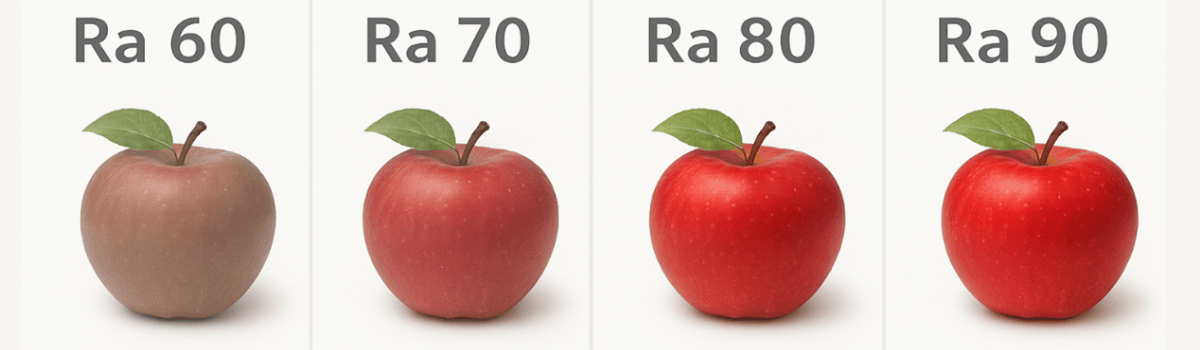
A high-CRI light source allows objects to appear natural, balanced, and visually accurate. Colors look vivid without being exaggerated, and familiar elements such as skin tones or food appear as expected. In contrast, low-CRI lighting often causes noticeable distortion—reds may appear dull, greens can look unnatural, and overall visual clarity is reduced.
It is important to clarify that CRI is independent of brightness and color temperature. A cool white LED can have excellent color rendering, while a warm white source may still perform poorly in color accuracy. CRI focuses solely on how well colors are reproduced, not how the light looks in terms of warmth or intensity.
How CRI Is Calculated and Interpreted
CRI is determined by comparing a test light source with a reference light source under standardized conditions. A series of color samples is illuminated, and the differences in appearance are measured to produce a final score, commonly referred to as Ra.
The standard calculation is based on eight relatively soft color samples. This approach ensures consistency, but it also introduces limitations. Because these samples are not highly saturated, they do not fully represent real-world objects such as fresh meat, fabrics, or skin tones.
For this reason, professionals often pay attention to additional indicators, especially R9, which represents deep red rendering. Although it is not included in the general CRI value, R9 has a strong influence on visual quality in many applications.
In practical evaluation, a reliable high-quality light source typically shows:
◎High general CRI (Ra ≥ 80 or ≥ 90 depending on application)
◎Stable spectral distribution
◎Acceptable performance in key color indices such as R9
Without considering these factors together, CRI alone may not accurately reflect real lighting performance.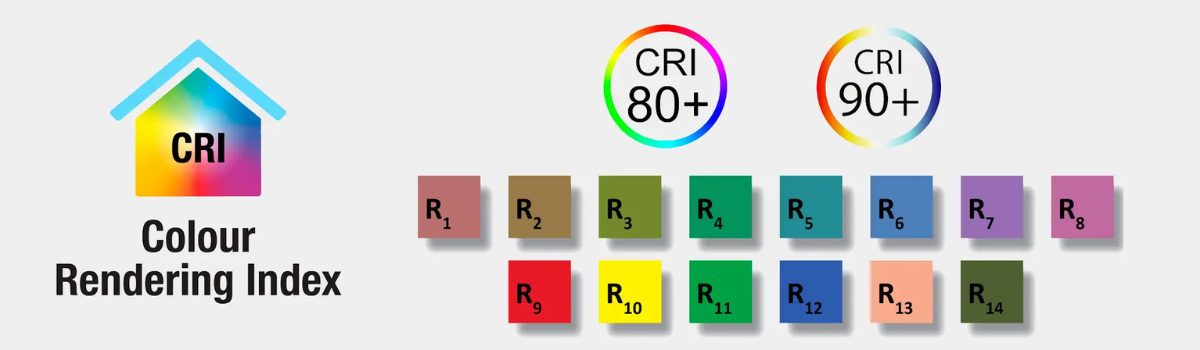
Where CRI Matters in Real Applications
The importance of CRI is not universal; it varies significantly depending on how lighting is used. In some environments, it directly impacts visual quality and decision-making, while in others it plays a secondary role behind efficiency.
In commercial and retail lighting, CRI is closely linked to product presentation. Lighting is part of the visual marketing strategy, and color accuracy directly influences how products are perceived. High-CRI lighting enhances color vibrancy and helps maintain consistency with natural appearance, which is especially important for fresh food, clothing, and cosmetics. Poor color rendering, on the other hand, can make products look dull or misleading, reducing their attractiveness and perceived value.
In healthcare environments, CRI becomes far more critical. Accurate color perception is essential for observing subtle differences in skin tone, tissue condition, and blood characteristics. These visual details often carry diagnostic significance. Lighting systems used in hospitals and clinics therefore require not only high CRI, but also strong performance in red wavelengths to ensure reliability.
For photography, film production, and broadcasting, CRI directly affects image quality. Cameras are sensitive to spectral imbalance, and deficiencies in color rendering can lead to unnatural results that are difficult to correct during post-production.
This ensures that captured images remain consistent with real-world perception.
In horticulture lighting, CRI is not the primary performance metric, as plant growth depends more on specific wavelengths than on visual color quality. However, extremely low-CRI lighting can create uncomfortable working conditions and make it difficult to inspect plant health. In environments where human interaction is important, such as indoor farms or research facilities, a balanced approach is often used:
◎Maintain efficient plant-growth spectrum
◎Introduce partial full-spectrum light for visibility
This improves both operational comfort and visual assessment without significantly reducing efficiency.
Outdoor and industrial lighting has traditionally prioritized luminous efficacy over color quality. However, this trend is gradually shifting. With modern LED technology, improved color rendering can now be achieved with relatively small efficiency trade-offs. In urban environments, higher CRI contributes to better visibility, clearer object recognition, and improved perceived safety, making it increasingly relevant even in large-scale installations.
The Balance Between CRI and Efficiency
One of the key considerations in LED design is the trade-off between CRI and luminous efficacy. Achieving higher CRI typically requires a broader and more balanced spectral distribution, which can reduce overall efficiency.
Lower-CRI LEDs are often more energy-efficient and suitable for applications where cost and performance are the main priorities. In contrast, high-CRI LEDs provide superior visual quality but may consume slightly more energy or produce fewer lumens per watt.
This is not a limitation, but rather a design choice. The key is to match the lighting solution to the application:
efficiency-focused scenarios → moderate CRI is acceptable
visual-critical scenarios → high CRI is necessary
A well-designed LED solution finds the right balance instead of simply maximizing one parameter.
Conclusion
The Color Rendering Index is more than just a specification—it is a key factor in determining how effectively a lighting system supports human vision. From enhancing product presentation to enabling accurate professional judgment, CRI directly influences how light is experienced in real environments.
For LED manufacturers and lighting designers, the goal is not simply to achieve the highest possible CRI, but to apply it appropriately based on application needs. By understanding both its strengths and its limitations, and by combining it with broader spectral design strategies, it is possible to deliver lighting solutions that balance efficiency, visual quality, and real-world performance.
Table of Contents